.png)
“Never, never yet in all my life have I felt anything like this: It is a blow to myself, to his people, to the church of Christ in Scotland.”
This is what Andrew Bonar said when his friend Robert Murray McCheyne died, just months from his thirtieth birthday.
Every so often, you come across a young man, and they're not your typical young man. They have a depth to their whole being, while their peers are shallow. Their chat is serious in the middle of banter and lightness. And the have a big, eternal perspective on life already, while everyone else is still living for the moment.
Robert Murray McCheyne was such a young man. His life was short, but the record left of his life is inspiring.
He did not waste his years as a young man.
Here are more descriptions of him, from some of the men who knew him well.
“... he had more of the mind of his Master than almost any one I ever knew.” (Robert S. Candlish)
“He preached with eternity stamped upon his brow.” (Duncan Matheson)
“I never knew one … so impressed with the invisible realities, and so faithful in reproving sin and witnessing for Christ.” (Alexander Moody-Stuart)
I want to trace a five year period from his conversion at age 18 until he was 23, and about to be ordained as minister in Dundee.
What happened in Robert’s heart in those years?
First, a very quick sketch of his early life.
He was born in 1813.
His parents were well off, and could afford to give Robert an excellent education in Edinburgh, which was in its heyday as a centre of learning.
He was a bright kid, took to languages really quickly and loved poetry.
By 14 he was off to university in Edinburgh, which I'm told was normal enough at that time in history.
His family was very religious, and Robert was on all appearances one of them. But he wasn't saved.
At 18 he loved dances, music, playing cards and enjoying his social life of Edinburgh.
And then his brother died. David was the eldest of the family and a godly young man. His death shook Robert from his spiritual sleep and worldliness.
Months after his brother’s death, Robert wrote a poem. It ends with Robert remembering his brother’s eyes:
Ah! How oft that eye
Would turn on me, with pity’s tenderest look,
And, only half-upbraiding, bid me flee
From the vain idols of my boyish heart!
The period surrounding his brother's death was a time of deep conviction of sin, of turning to God from the World. At some point here, Robert was saved.
A few months later he commenced studies in the Divinity Hall in Edinburgh, to prepare to be a minister. Initially he could still be persuaded to join in with friends in playing cards and enjoying in the fun and parties. But very soon his journals show his determination to turn from the world, to give up worldly pleasures and go all-in for Christ:
‘Dec. 9.–A thorn in my side–much torment.’
‘March 10th, 1832–I hope never to play cards again.’
‘April 10th–Absented myself from the dance; upbraidings ill to bear. But I must try to bear the cross’
A little later - ‘Dec. 18–(After spending an evening too lightly) ‘My heart must break off from all these things. What right have I to steal and abuse my Master’s time? “Redeem it,” he is crying to me.’
Again the next year he fell back into the old pleasures, but writes:
‘This last bitter root of worldliness that has often betrayed me has this night so grossly, that I cannot but regard it as God’s chosen way to make me loathe and forsake it for ever. I would vow; but it is much more like a weakly worm to pray. Sit in the dust, O my soul!’
This sense of turning from wasteful and worldly things, and of redeeming the time for the Lord marks his life going forward.
‘His kingdom occupies the most part of all my thoughts, and even of my long-polluted affections’
‘August 15.–Little done, and as little suffered. Awfully important question–Am I redeeming the time?
‘March 12, 1833.–O for activity, activity, activity.
‘June 4.–Evening almost lost. Music will not sanctify…’
In March 29, 1834, having finished college, he wrote. ‘My last appearance there. Life itself is vanishing fast. Make haste for eternity.’
Shortly after his conversion, his friendships take a new form.
He cultivates spiritual friendship with a few young men. And this seems to have been hugely formative.
First was Alexander Somerville, who had been his pal before his conversion. ‘About this time having been brought to taste the powers of the world to come, they united their efforts for each other’s welfare.’ They met for study, to practice Greek and Hebrew. More often, they met to pray and to have serious conversation.
Sometimes, he records times when he enjoyed good conversation with Alexander on long walks. ‘Walking with A. Somerville by Craigleith. Conversing on missions.’
At the Divinity Hall, Robert came into contact with a group of young Christian men, and they formed quite a brotherhood. In this group was Andrew Bonar, who became perhaps his closest friend. It is worth noticing the activities of these young men. The four years of study together was a time of true spiritual friendship. They pushed each other on in the pursuit of God and godliness.
During summer holidays, Robert, Andrew and any other students who had remained in town, met weekly to study the scriptures and share ‘the amount and result of our private reading’.
Throughout the term, 18 young men met on Saturday mornings at 6.30 for what was called ‘exegetical society’ - they studied Biblical criticism, Jewish literature, scripture geography. Every meeting was opened and closed with prayer. Minutes of the discussion were kept; and the essays read were preserved in volumes.
At University, Robert joined a number of societies – one was for visiting the poor and needy in Edinburgh. ‘The sole object of which was to stir up each other to set apart an hour or two every week for visiting the careless and needy in the most neglected portions of the town.’Andrew and Robert served together in this work: He writes in March 1834, ‘Accompanied Andrew Bonar in one of his rounds through some of the most miserable habitations I ever beheld.’
And after they had graduated, the spiritual friendship continued. They began a custom of praying specially for each other on a Saturday evening, in reference to their ministry the next day.
And later, when Robert travelled to Palestine for six month to explore the possibilities of missionary work, it was with his dear friend Andrew. As he prepared to travel, he wrote to him (March 12): ‘You know, dear A., I could not labour in this cause, nor enjoy it, if you were not to be with me in it.’
The second big influence was biographies.
Robert looked for examples to follow and often wrote prayerfully about the lives of faithful men who had served God before him. His journals are littered with references to biographies he read. But these are not dry records. Robert let their lives stir new spiritual desires within himself.
‘November 12.—Reading H. Martyn’s Memoirs. (A bright young man who left everything and travelled to South America as a missionary). Would I could imitate him, giving up father, mother, country, house, health, life, all—for Christ. And yet, what hinders? Lord, purify me, and give me strength to dedicate myself, my all, to thee!’
‘December 4.—Reading Legh Richmond’s Life.’ (a minister from early 1800s).
Then in Latin, ‘Deep penitence, not unmixed with tears. I never before saw myself so vile, so useless, so poor, and above all, so ungrateful. May these tears be the pledges of my self-dedication.’
‘March 20.—Read part of the life of Jonathan Edwards. How feeble does my spark of Christianity appear beside such a sun! But even his was a borrowed light, and the same source is still open to enlighten me.’
‘June 27.—Life of David Brainerd. (young man who went to be a missionary among the Native Americans in New Jersey) Most wonderful man! What conflicts, what depressions, desertions, strength, advancement, victories, within thy torn bosom!’
Then the next day.
“O for Brainerd’s humility and sin-loathing dispositions!’
‘August 13.—Reading Adam’s Private Thoughts.’ … which begins with Confessions of sin.

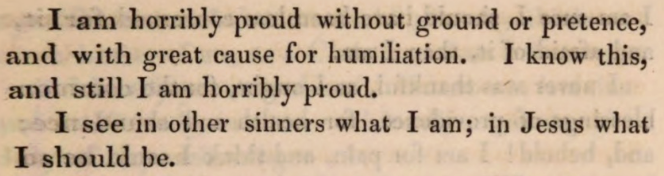

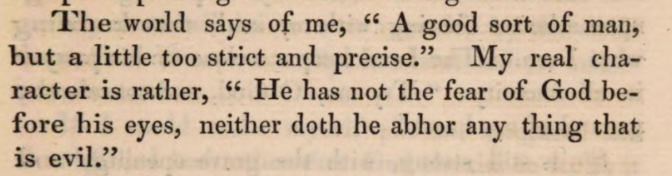
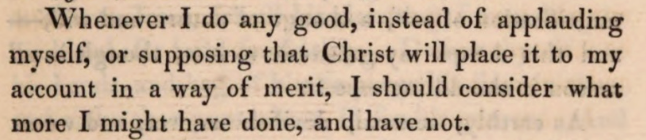
Robert reflects: ‘O for his heart-searching humility! Ah me! On what mountains of pride must I be wandering, when all I do is tinctured with the very sins this man so deplores; yet where are my wailings, where my tears, over my love of praise?’
This all shows the value of keeping a journal and writing. Robert made time for self-examination, for learning from the day’s experiences, from the books he read and the people he met. His journal turned his the record of life into prayer. Through his journal his spiritual desires were cultivated.
‘June 30, 1833.–Self-examination. Why is the missionary life so often an object of my thoughts? Is it simply for the love I bear to souls? Then, why do I not show it more where I am? Souls are as precious here as in Burmah. Does the romance of the business not weight anything with me?—the nice journal and letters that I should write and receive?...’
‘November 14.–’...I fear the love of applause, or effect, goes a great way. May God keep me from preaching myself, instead of Christ crucified.’
After reading Baxter’s Call to the Unconverted, he wrote in verse, ‘Though Baxter’s lips have long in silence hung, and death long hush’d that sinner-wakening tongue;
Yet still, though dead, he speaks aloud to all …
Then concludes,
‘O grant that we, when sleeping in the dust,
May thus speak forth the wisdom of the just.’
Once when laid down in his sick bed, which became a feature of his short life, he wrote another poem, ‘He tenderly binds up the broken in heart, the soul bowed down he will raise…’
Another theme in these years is the cultivation of heart and mind.
It’s one thing Robert consciously sought throughout his studies – more heart, more tenderness. He feared becoming a dry academic, a cold preacher of the word. This theme appears again and again in his journals:
September 2, 1832.–Sabbath evening.–Reading. Too much engrossed, and too little devotional. Preparation for a fall.
‘March 8, 1833.–Biblical criticism. This must not supersede heart-work.’
In 1836, when he had began to preach, we find this theme again:
‘Feb 21. –In the morning was more engaged in preparing the head than the heart.’
Then on Feb. 27.–Preached in Dunipace with more heart than ever I remember to have done… owing to the gospel nature of the subject and prayerful preparation.
Again, on March 5. ‘Preached in Lambert with very much comfort… The heart and the mouth were full. “Enlarge my heart, and I shall run,” said David. “Enlarge my heart, and I shall preach.”’
On April 6, he writes similarly, ‘Preached with some tenderness of heart. O why should I not weep, as Jesus did over Jerusalem?
June 11, “...Today sought to prepare my heart for the coming Sabbath. After the example of Boston, whose life I have been reading, examined my heart with prayer and fasting.’
The next day, he writes, ‘Today a sinner preached Jesus … a day of much help, of some earnest looking-up of the heart to that alone quickening power…’ yet he adds, ‘of much temptation to flattery and pride’.
June 15, he continues, reflecting on the gospel. ‘Surely it is a gentle message, and should be spoken with angelic tenderness, especially by such a needy sinner.’
One day, when Andrew Bonar shared with him that he had preached on the text, ‘The wicked shall be turned into hell’, Robert had replied, ‘Were you able to preach it with tenderness?’
Again, July 3. – ‘O when will I plead, with my tears and inward yearnings, over sinners! O, compassionate Lord, give me to know what manner of spirit I am of! Give me thy gentle spirit, that neither strives nor cries. Much weariness, want of prayerfulness, and want of cleaving to Christ.’
He seemed so concerned about his heart’s posture when preaching.
Not only to care for souls.
But to preach for Christ’s honour alone.
Once when he was laid aside in sickness and could not preach, he wrote, ‘The Lord saw I would have spoken as much for my own honour as his, and therefore, shut my mouth.’ Then this great line, that I love, ‘I see a man cannot be a faithful minister, until he preaches Christ for Christ’s sake–until he gives up striving to attract people to himself, and seeks only to attract them to Christ. Lord, give me this!’
Again, another time, he writes:
‘I have been too anxious to do great things. The lust of praise has ever been my besetting sin; and what more befitting school could be found for me than that of suffering alone, away from the eye and ear of man.’
In a letter to Andrew Bonar he says, ‘I feel distinctly that the whole of my labour during this season of sickness and pain, should be in the way of prayer and intercession.
This learning to pray, learning complete dependence on the Holy Spirit, is also a theme in these early years of service:
I love this entry, from July 3, 1836: ‘O Lord, make me hang on thee to open their hearts, thou opener of Lydia’s heart. I fear thou wilt not bless my preaching until I am brought thus to hang on thee.’
Finally, I want to mention His experience of the real world.
These years were not confined to prayer and self-examination and writing and spiritual conversations with good friends, or reading biographies and good books, or careful Bible Study.
Robert was also being formed and prepared as a servant of Christ, through his experiences in the real world. In his visitation of the houses around Dundee and then later in Larbert and Dunipace, he saw first hand the mess of sin and the pain of suffering.
I’ll again quote him from his journal, as he processed these experiences. After visiting the poor homes around Castle Hill in Edinburgh, he wrote this:
‘Ah, Why am I such a stranger to the poor in my native town?... What imbedded masses of human beings are huddled together, unvisited by friend or minister! “No man careth for our souls,” is written over every forehead. Awake, my soul! Why should I give hours and days any longer to the vain world, when there is such a world of misery at my very door?’
From then on, he regularly visited the homes in the Canongate area, teaching a Sabbath school, and distributing a monthly magazine.
His journal records some of these visits:
‘Entered the house of – –. Heard her swearing as I came up the stair. … Her father-in-law entered, a hideous spectacle of an aged drunkard, demanding money.’
In 1836, when he had moved to serve in Larbert and Dunipace, he continued to visit house to house.
Sometimes, he would visit many homes in one day,
May 17. – Visited thirteen families, and addressed them all in the evening.’
He shepherd heart was cultivated in these experiences.
He knowledge of the world and sin and suffering, made him a more serious servant, and a more tender, discerning shepherd of souls.
The four years of study, followed by ten months of service in Larbert and Dunipace came to an end.
Robert Murray McCheyne soon became a minister of the church in Dundee. But we will leave his story there.
There is probably more we could have mentioned, but I’m encouraged to see those things that God used to form Robert Murray McCheyne’s heart. To give him eyes to see invisible realities, to preach from the brink of eternity, to be ready to speak to sinners with urgency and tenderness. And to be completely devoted to Christ.
The voice of death, a clear turning away from worldly activities, the benefit of spiritual friends who stirred him in his Bible study and pursuit of holiness, the examples of faithful men found in biographies, the use of journaling and writing poems, and setting aside time for prayer and fasting and preparing his heart for ministry, along with the experiences of the real world and the school of sickness, these all shaped a young man for God.
I’ll finish with what Martyn Lloyd-Jones said about Robert:
You remember what was said of the saintly Robert Murray McCheyne of Scotland in the last century. It is said that when he appeared in the pulpit, even before he had uttered a single word, people would begin to weep silently. Why? Because of this very element of seriousness. The very sight of the man gave the impression that he had come from the presence of God and that he was to deliver a message from God to them. That is what had such an effect upon people even before he had opened his mouth. We forget this element at our peril, and at great cost to our listeners
.png)